Friday, January 23, 2015

A whole year without...

There honestly isn't much I miss of accepted home comforts during this life we're living on Impetuous. What people who live in houses in the western world take for granted doesn't appeal to me. I don't dream of central heating or cooling, TVs, cars, limitless electricity or piped hot and cold water.

Catching our own fish and water, using only what power is produced by our solar panels, doing our own laundry by hand and finding what we can, without spending too much, comes naturally to me as someone who likes to live frugally and pay attention to our environment.

I don't find being out of contact a wrench, although I'm learning that almost having internet or patchy phone contact is much more frustrating than none at all. I love the way that if we have a problem we have to rely on ourselves to sort it out. Risk is assessed in a slightly different way when you don't have the safety nets we're used to.

I don't wish our life was easier either. I actually really enjoy rowing ashore and finding out how we will organise water, gas or recycling in each new place.  Looking around to find the cheapest shops and hunting out markets for fresh stuff or even better finding what is growing wild is never a chore but an engaging way to spend our time.

We both equally choose not to have an outboard motor, or expensive electronics such as chart plotter, autopilot, radar, watermaker, or electrical anchor winch; our 'raison d'etre' is not for our life to be as easy as possible (or for that matter to be as hard as possible) it just comes naturally to both Duncan and I to relish some challenges in our lives. We're young and need to do exercise. Pulling up the anchor chain, lugging about water jugs, rowing, walking or cycling about keeps us happy and healthy.

Nor do I long to stay in a marina in order to use the facilities. This year (February 2014 in Guatemala to January 2015 here in New Zealand) we have stayed in a marina a grand total of one night. This was Shelter Bay in Colon, Panama and cost us over $50 US for one night; we hated it. As soon as we found out there was an anchorage possible instead, we moved there.

We're not purists; we have a very efficient fridge which we can make ice in, two cheap ($200) computers and a diesel engine on our boat but in short I'm extremely content with exactly what we have on Impetuous and if I felt something was lacking I'd be working on sorting it out. Having said all this there is one thing that I have really been missing this whole year whilst we've been away from the UK...  

For an entire year I have not experienced the shear unbridled joy of a long, luxurious hot bath.

That is, until last night when we anchored off Smokehouse bay on Great Barrier island. In this bay, for free community use by any boater is a bathhouse. Built by Eric Webster and maintained by his family and the community which uses it. There is a smokehouse to prepare your fish, a campfire area with benches, tree swings, mangles and washing lines, an area to dry out your boat for maintenance on the tide and best of all the bathhouse. It's a simple system with rainwater caught from the roof, a fire with a backboiler outside which gravity feed heats a big hot water tank inside. A beautiful cast iron bath in a lovely clean, spacious yet cosy room. The water was copious and boiling hot after tending the fire for a few hours.

The joy; I cannot tell you...      


Thursday, January 8, 2015

End of an Era...

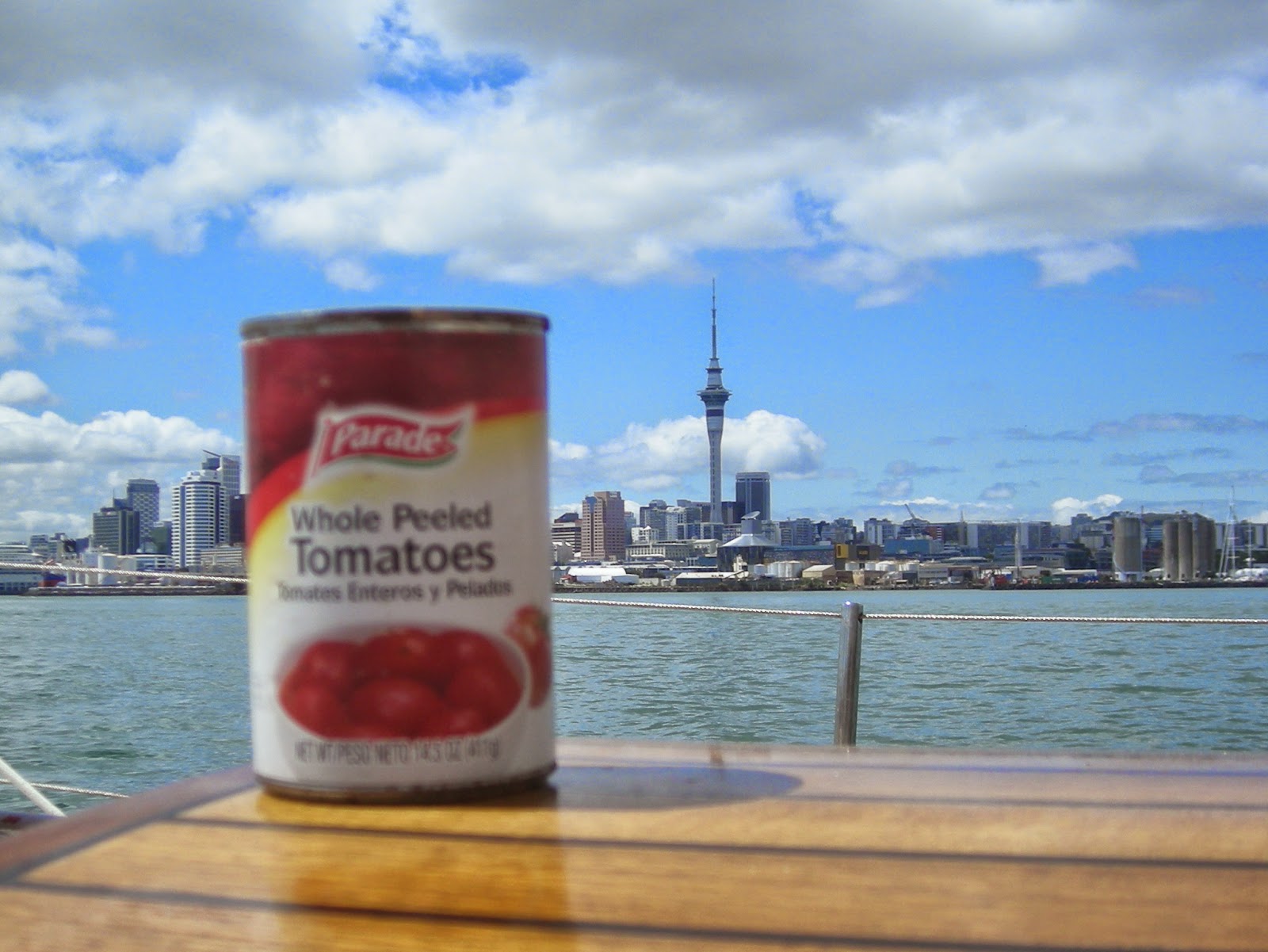
With Christmas and New Years' celebrations over...  With last years aim of crossing an ocean crossed...  As friends take their boats out of the water, or spirit them away to marinas stripped of sails thinking of earning some money here in New Zealand or travelling in a different way for a while...  It feels very much like we are reaching an end of an era. And so I realised we are; when I rummaged around to find that we were down to our very last can of American bought tomatoes.


It was a happy day back in February of 2013 when a special offer saw the price of canned tomatoes drop to three cans per dollar at our local store. We had been studying the market for a while where we were working on the boat in Dickinson, Texas and knew that this was the time to buy buy buy.

We knew that there would be places over the coming years where you could expect to pay a considerable sum of money for our staple and we wanted to be sure we would never run out until we could buy them cheap again.

'Can I have eight cases please?' I asked at our local store, 'As I'm buying so many can I have a discount?' (I had to try) 'No way. They are on offer three cans for a dollar, that IS the discount' came the reply. 'You can pick them up tomorrow.'

Cans for us means one thing; tomatoes.  This simplicity is very helpful when the labels come off. Argued there could always be a few odds and sods to be found; maybe an artichoke here, some chipotle chillis there, or a sauerkraut may sneak in... if they're small they may be water chestnuts, but generally all cans we carry and use are tomatoes.  We mix them with beans for chilli or a herby breakfast mix; we use them as a base for many curries, pasta sauces and various soups; and I love to make pizzas whenever we can face the heat of the oven!


Stacked up on the galley side they gave us a real sense of achievement. We had come a long way and the goal was well and truly within sight. We had bought four years prior, what many might have regarded as a wreck of a boat. Though Impetuous was still out of the water, it wouldn't be long until she was launched and we would be sailing off on her. Here we were, stocking up on tomatoes that would last us until we were somewhere totally different.

During the years on Impetuous our 192 cans didn't all rust and no, we didn't varnish them. Before crossing the Pacific we did re-order them, checking for damage. We had a slight list to starboard, in part caused by our food stores, so as we were going to be sailing on a port tack for a month or more, it was time to shift to port anything heavy... Who says cruisers don't think of these things!

It will be with both sadness and joy that we open that last can of tomatoes. An end of an era suggests a loss.  But we will be happy to have crossed an ocean with no shortage of canned tomatoes, happy to have never paid silly money for more supplies and happy not to have died of botulism!   

Tuesday, December 16, 2014

Time to Creep up a Creek...


It's little wonder that settlers from Cornwall, Scotland and Ireland felt so at home in New Zealand. With her rugged, meandering coastlines which are often enshrouded in thick blankets of rain sodden cloud; the similarities to their homelands are easy to see.


The fair weather that had kindly swept us to these pleasant isles, had been pushed aside by the more boisterous weather that we'd feared might welcome us. Fortunately we were tucked away in relative shelter by then. With more gales forecast for Sunday and the next few days, we thought it might be time to hide further.

The temptation was to explore up a narrow estuary; as I would in Cornwall. Tucking our boat safely away in some sheltered pool far up river. The tide cutting off access as it drains away, with Impetuous safe from the ravages of the wind.

The image of the weathered sailor waking in the small dark hours of morning to catch the tide is often used but seldom the reality. After a peaceful lie in with our books and several cups of tea, followed by a leisurely breakfast and then coffee; we were ready to wind slowly up the Keri Keri river with the last of the rising tide.

Despite several shallow patches, we were pleasantly surprised at how effortlessly we were able to creep up the estuary without ploughing our keel into the soft mud, always carrying a healthy margin of 50 cm under us.


The river wound its way beyond many twist and turns, passing rolling hills drenched in leaden cloud. Upon each turn the wind that had swept us up lessened as we found our intended shelter. Then at one juncture it left us altogether. We started the engine; which we now refer to as the shoe dryer as we have resorted to drying our shoes upon its hot carcass after any use. 

Eventually we arrived at the estuaries head; 'Standing Stones' where the river is no longer navigable. This is the site of the oldest stone store in the country.  It was built by early traders to store grain and then used as a trading post when they found Northland too wet to grow grain. An impressively solid building, which somewhat dwarfs the white washed timber house located next door; the oldest building in New Zealand.


We walked up from the stone store in that hybrid of precipitation; mizzle. Thicker than mist but thinner than drizzle, mizzle has that unique quality that somehow soaks your clothes from the inside out. It was not to last. As the mizzle gave way to drizzle we lingered in the shops that had the heating on. As we trudged wearily back to the boat at the end of our day, the drizzle turned to rain.


How quickly things change; it was merely a couple of weeks ago that I relished an icy cold beer as it trickled down my throat.  Now we've taken to placing our wine in a saucepan of hot water to get it to what; without fire, we dream of being room temperature. The idea of cold beer now just makes us shiver. Still I'm sure it will be summer soon.


Wednesday, December 10, 2014

Last big passage of the year...

There's nothing quite like the whirr of a wind generator to spur you on for your next voyage. We had encountered the one in motion next to us, together with it's haphazard owner before. As it squealed it's way round up to terminal velocity and back down with every gust, we had no confidence that it would not disintegrate and ornament our boat and potentially our heads with shards of shrapnel. We had to get away from them both...

It was with mixed feelings that we pulled in our lines and anchor from Nuku'alofa's FREE harbour. On one hand Tonga was refreshingly gritty, interesting and fun. On the other hand the fact that it was the very end of the season and all the moderate organised people were already tucked up in New Zealand meant that our neighbours for the last week had all been of a certain ilk... Let me just say that it made for some great parties but it was time to have a dry, quiet week at sea.

We'd walked about the wonderful main market with temperance in mind. There's no good in loading up your boat with sumptuous tropical fruits and weird and wonderful root vegetables in order to check in to New Zealand and see the whole lot go into a big plastic sack headed for the incinerator. New Zealand as an agricultural nation has a real 'thing' about keeping out the pests and viruses it feels threatened by. All through the Pacific rumours flew amongst boaters as to the extent of what would be confiscated. Shells, feathers, stones, baskets, seeds, nuts, beans, lentils, rice, coffee, cocoa... what would they take?

It was the second time of our trip so far, that we'd met someone who cared about spices as much as us. After we'd had our 'spice swap' we really needed to confront the elephant in the room. Gaya like us was facing the threat of her hard won and precious collection being confiscated and our discussions turned to hiding places. Innocently in our view; it's not like the threat seemed big... but just the chance that they might decimate our collections meant we were being inventive. Tim finally brought reason to the table 'you're talking high scale smuggling if you hide the methi seeds there!'


In the end I emailed the biosecurity department in New Zealand asking for up to date and specific guidance. We were extremely reassured to hear that many herbs and spices were allowed and others; namely the whole seed variety were subject to inspection. The inferance was that if the inspector had cause for concern they could throw all kinds of things out but that they probably wouldn't. Thus placated we only hid a couple of particularly coveted items just incase we came into contact with an overly zealous inspector.

Even when we were in the Atlantic I'd been thinking about this passage to come. There are many stories about yachts coming to grief on their trip to New Zealand and several boats are lost in her surrounding waters each year. As we got closer, the people we spoke to, who knew, were much more relaxed about the passage. 'Leaving in November or December, it's the best time, it'll be summer when you arrive.' 'I've done it more than twenty times, you'll be fine, don't worry!' So when we set off we were ready for whatever. The forecast seemed like it would be fairly light winds but as we still can't get up to date forecasts at sea yet; we knew this could change as we got near New Zealand and our week old forecast ran out.
 

We started out Saturday early evening, just clearing Tongatapu by sunset. The breeze was gentle so we were sailing beautifully with all the sails out at around 7knots. The next night the wind got slacker so we discussed the possibility of stopping at Minerva Reefs. We'd not planned to, but a few people had recommended it to us. Intrigued we thought we'd have a look; it was on our way in any case. The wind got up again as we approached but it seemed churlish to miss it so, as we'd arrived at 1am we reefed and carried on for a few hours then sailed back to the pass.


Minerva reefs are two separate coral reef fringed lagoons around 30 miles apart. We entered North Minerva through the unmarked pass just after sunrise, which was obvious by the disturbed waters of the outflowing current. We sailed across the calm lagoon to anchor in the lee of the Reef in the North East corner, had a fry up and then snorkelled out to the reef. The water was markedly cooler and there wasn't much going on. We had the whole place to ourselves,but we didn't need to wait out any weather, it was perfect, so we decided to crack on.


In many ways, even with our restraint in Tonga, the passage was one of almost constant eating as we tried to consume all that we feared might be taken. Meals almost snowballed into each other, as we both expressed the gastronomic concerns we shared over our stocks by cooking and eating them. Breakfast the day we arrived, for example, was left over lamb curry; New Zealand lamb ironically. To compound our worries, it was by far our most successful trip with regard to fishing. The information we had received said no meat. Though we've met plenty of vegetarians who claim fish isn't meat we had our doubts. As it turned out we needn't have worried and we still have a freezer full of fish.


It turned out that the rules were; all fresh fruits and vegetables were thrown out, no questions asked. After that they wanted to see each cupboard where we kept foods but all they took were all dried beans and popcorn. Flours, lentils, quinoa, bulgar, sesame and flax seeds, pasta and rice were all ok. No meat; fresh, frozen or tinned is allowed, freshwater fish; canned or fresh is likewise prohibited but sea fish are fine. They never asked about spices and seemed in a tremendous hurry to chuck a few things out and then move on. They were probably only on our boat for around twenty minutes, it was a bit of a whirl. Wonderfully it was all gratis; we have a six month visa and the boat is fine to stay up to two years.

So here we are in the Bay of Islands. Look at our landfall photos; it's just how we both remember New Zealand to be; a thick veil of cloud covering the impressive landscape.

 
Down with the Tongan flag and up with the Kiwi; woolly hat covers still bad hair...
 
 
This was our landfall... can you see what it is yet?  It's less than two miles away!


Friday, November 28, 2014

Spring Clean

We were both having bad hair days when we took our Tongan flag picture so I thought it would be more interesting to include this grave decoration instead.  The Polynesian graves are often very bright and colourful with murals of the deceased.  This family must have been patriotic.


The Kingdom of Tonga has four distinct island groups running North to South over around 500 miles. It's population of around 112,000 live largely on the coralline island of Tongatapu to the South with it's administrative capital Nuku'alofa, along with its king. Vava'u to the North has the town of Neiafu, between these two is the geologically varied Ha'apai group . Further north are the Niuatoputapu group which we didn't visit as the anchorages looked tricky and it was out of our way.  


The islands are formed along the Tongan plate and Tongan trench boundary so there is a lot of volcanic activity in the area.  The western islands are volcanoes created by the Pacific plate subducting under the Australia-India plate at the Tonga trench. The eastern islands are on the Tongan ridge and are largely either low coral limestone islands or sandy cays with a lot of coral reef growing around and between them.  We stayed well clear of areas of recent volcanic activity. There are two islands which periodically appear and then are eroded back away by the sea and there are tales of how when a big bubble of gas erupts from the sea bed your boat could fall into the huge hole in the sea it would create!


When we left the Vava'u group we hadn't checked the weather forecast for a while so were surprised to be struggling to find safe anchorages sheltered from the strong Northerly then Westerly winds as a deep low pressure system passed over. Once this had cleared up we were able to check in and move on along this island chain.

On the island of Haafeva where the trees were dripping with mangos, we were set wondering what the pigs might taste like. We couldn't find anyone selling the meat or doing much else. It felt a bit like New Orleans post Mardi Gras; people were wandering around looking a little vacant with bloodshot eyes presumably from too much Kava. The supply boat had recently unloaded and there had been a wedding and birthday parties. Kava is a root vegetable that is cooked up into a drink and taken as a mild narcotic in several Pacific islands. The only trade we could see going on was a fuel hut with a young guy hand pumping from barrels which had been so recently delivered with a queue of skiffs up the beach.


We were sad to miss visiting Tofua; off which the bounty mutiny occurred; where there is an active volcano. I'd been looking forward to the possibility of hacking our way up to the bubbling lava and steaming lake on this unpopulated island. However, our chart showed the island as only a featureless blob and the wind was still blowing out of the West meaning we would have had a hard slog to windward with uncertain chances of protection. The reefs of these islands can be quite sporadic and unpredictable. Our charts turned out to be largely accurate but certainly could not be relied upon so sailing at night was very much out of the question. We'd several times be looking out for a patch of reef to one side or another only to find ourselves suddenly sailing over it; hard to know which way to go at that point as you can't be sure how high it will have grown up.

As we have been hopping between the islands we have used this opportunity to give the whole boat a big clean. When we launched Impetuous last year, we simply loaded up with all our work in progress and took the lot to Clear Lake. When it was time to go, we just piled everything into the boat without too much thought or organisation. We've since been through our cupboards a few times but with the impending inspection by the New Zealand authorities we thought it high time to have a spring clean. The whole process has been quite cathartic; we've thrown out all remaining cardboard together with quite a few cockroaches, treated everywhere to stop them coming back, set aside beans and popcorn to be given away to our Tongan neighbours as they are not allowed in New Zealand; all in all we've gained three empty cupboards! We have used up the last of our varnish giving the mast a couple more coats and started sewing up a new flag.


We'll leave for New Zealand in the next couple of days on our last big passage of the year.  Here's a few more photos of Tonga.


Wednesday, November 26, 2014

Mariners' Cave

We are currently in Tonga, soaking up the last of the tropical season before we head south to New Zealand; out of the tropics, out of the coming cyclone season, and into the fast approaching summer of the southern hemisphere. All the same, after almost a year in the tropics we're expecting a big temperature drop; so much so that our down duvet was retrieved recently, during a head-sail sail change, from where it lives when not in use. We're both trying to remember where we have stashed our warm clothes; gloves, hats, scant provisioned waterproofs and the thermals I bought ten years ago in New Zealand: The last time I visited during summer. Ready for our trip south.

We still do have a little time to explore this wonderful Kingdom; not often one gets the chance to say that. Only the other day; when clearing in to the Ha'apai group, we sat on regally decorated chairs.

Also enjoying themselves here; whilst thinking of the final step south; seem to be most of the stragglers of the Pacific season. Like us, comparatively young and care free (and un-insured!). Some of the boats we had seen during our time in Polynesia, but never got the chance to say hello to, are here. Others we've met too; new and old friends alike. Couple this with our arrival coinciding with a big fancy dressed Halloween party; perhaps you can imagine how we spent our first few days in these islands.

There was one adventure that the Vava'u group of these islands had to offer, that Ruth was insistent that we should not pass up; Mariners Cave. A cave that can only be accessed by diving under the water through its entrance then bobbing up into a limestone auditorium; illuminated by the rays of the sun reflecting from the sea bed beneath. We found it hard to find as our outdated guide had no waypoints, only a rough description, and our electronic charts of the Vava'u group are quite out. 

Ruth thought we were in the right ball park and leapt over the side; with her mask, snorkel and fins. There is no buoy or possible anchorage, so my job was to hover on Impetuous, keeping an eye out upon the swimmer, and collect, when she reappeared. Ruth spent a few moments swimming around the area, locating the underwater hole in the rocks. By the time she had, my stomach had gotten the better of me and I had descended into our own cave upon Impetuous to find something to eat; only for a moment I hasten to add. When I peered out she had gone....


Not surprisingly I was on deck; a little more attentive, when she reappeared. I collected her from the water and innocently asked just where it was she had disappeared to as she had been gone at least 10 minutes. 'The streaks on the rocks, see, just there. Slightly to the left is a huge cave entrance, you can't miss it, its just a short dive under, into the dark!'

I popped up into the auditorium, stalactites hung from the roof of the lime stone cave. But there was not the haunting stillness one can sometimes feel when in such a cave. It was filled with the familiarity of the ocean. The slight swell breaking on the far wall of the cave as one floated around in the warm waters, seemed to prevent me from drifting off in the dark corners of the cave and my mind, where one would expect those vampires to be languishing. 

The sunlight shone from below causing the small wavelets to glow with indigo blue hues at times. When a bigger swell from outside entered the cave one's ears would start to pop as the pressure rose; also causing, we think, a moment of fog on top of the waters' surface as the water vapour in the air started to change state as it was compressed. Then the swell would flow back out, and all would revert to normal. Once again one would be mesmerised; staring at the hues of the water and the geology of the caves, as the sun's strength changed outside.

Should you be visiting these islands, don’t miss the chance to go to mariners cave; especially if, unlike us, you have an underwater camera. 

Aim for a way-point of 18 41.42 S, 174 04.50 W and look for orange and white streaks on the limestone.

Luckily our friends Tim and Gayathra visited the same cave at a different time and have let us use their photo of Gaya swimming in, to give you an idea of the underwater entrance.


Sunday, November 2, 2014

In Sympathy with Bligh...

We'd clung to our anchor listening to the wind howl for a week in Bora Bora before we left. Then 24 hours out our breeze petered out to the occasional puff. Somehow in these conditions Impetuous manages to carry on in the right direction, but when we got down to one knot, we knew we were doing more harm to the sails than we were making headway. We cast a look around on the chart and spied Maupihaa (also known as Mopelia). We snuck into this atoll through the skinniest pass yet; it was only 18m across! 24 hours later the wind had returned so after a walk ashore we returned to sea.


The next morning Ruth's fever started. To this day we're not sure what it was, but she spent the next four days in bed shivering. Prior to leaving Bora Bora, we'd spoken to an English couple who had raved about the beauty of Aitutaki. 'How much do you draw?' they asked, '5ft7ish', 'oh you're lucky, you can get in'. It's funny how we, as sailors are happy to shoehorn our precious homes into a space that we just don't fit. If you were reversing into a parking space that was 10cm smaller than your car, your onlookers would never say, 'ah, a little scrape, you'll get in, you might have to climb out the boot!'. Duncan swam out the kedge anchor 4 times to drag us in through that pass and over the sandbar. Ruth struggled to steer and winch but once we were in, she was back to bed and feeling awful.

Lieutenant William Bligh left Portsmouth in December 1787 bound for Tahiti. After 30days battling mountainous seas and headwinds off Cape Horn they were forced to abandon this route and sail the other way around the world to get to their destination. They stopped at the Cape of Good Hope, Van Diemen's land (Tasmania) then stayed low below New Zealand to use favourable winds before looping round to Tahiti. His wooden sailing ship 'the Bounty' was small for the time; 85ft long 220 tons rated as a Cutter (though it had three masts) and she carried a crew of 46. Their voyage's purpose was to collect hundreds of breadfruit plants in order to transplant these to the Caribbean as an efficient food for slaves there.

Bligh steered his men through this very trying voyage with little apparent difficulty until he encountered a storm off Aitutaki. In sympathy with Bligh, as we dragged ourselves over that sand and coral our engine gave the most horrific knock. It made all manner of odd noises, ran away with itself and then died. Our concerns were heightened by the fact that we were being blown onto shallower water but luckily we were still stuck fast. After our fourth kedge we finally felt the boat even out as she found a little water under her keel. We tentatively started the engine and it gently muttered us into a spot where we could drop our anchor.


As far as we can tell, the problems that led to the mutiny of Bligh's crew lay in the fact that the men had a very good time on Tahiti. When they left, they were now facing another arduous slog of a journey in order to return to England where life was far from easy. Many of them had found lovers and made good friends in the garden of paradise that was Tahiti, and it was more than a wrench to give this life up.

We spent the next day troubleshooting the engine; Ruth from the bed with manual in hand, Duncan at the spanners end. In the background we were forever bumping the bottom, re-anchoring as the tide changed and the wind shifted and howled all the way round the compass. Still unsure what was wrong with Pip we were then Blighted once again when Duncan started to shake and sweat. We'd been there almost a week before we felt we could step ashore.

Aitutaki is indeed a beautiful island. It's hard to describe why, when it clearly lacks the iconic grandeur of Bora Bora, but the lagoon is shallow and brightly coloured whereas the island is verdant, luxurious and is populated by Maori descended Polynesian people who are endearing and delightful.


This photo was taken from climbing up the water tanks up top of the island.  That's why you see corrugated steel. This is just another beautiful tree full of the ear held flowers...


We'd struggled in the society islands to find much in the way of fruit and vegetables. This seemed in disparity to the lushness that was in evidence wherever you looked. Aitutaki was therefore a new kind of playground. When we walked away from the town we found trees rich with breadfruit, grapefruit, limes and chillis. In the petrol store they sold tomatoes cheaply, which were the most sumptuous we've tasted.


Bligh's crew mutineered off Tofua in the kingdom of Tonga, but the rumblings of discontent began off Aitutaki. Pip hasn't murmured any discontent since we left, and we're both now back to full health. Our sail to Tonga was beautifully peaceful and breezy. We'd been spectacularly unsuccessful with fishing ever since the Tuamotus so when we caught two good sized MahiMahi the day before we arrived we were delighted.